
To evaluate chain wear, begin by checking the pitch—the distance between two neighboring roller pins. This measurement can be accurately taken using a caliper or pitch gauge. If the measured pitch surpasses the tolerance specified by the manufacturer, it signals excessive wear and suggests that the chain needs to be replaced.
Why is the Chain Elongation Measurement so important?
Under conditions of proper use and regular maintenance, chain elongation can be used as a reliable indicator to estimate the chain’s service life. Poor quality chain may have premature elongation and needs to be adjusted the tension between sprockets or replaced frequently, which lead to production interruption and higher maintenance cost. Therefore, wear-resistant testing is one of the important characteristics of high-quality chains.
Chain Wear Resistance is related to the following factors:
1. Raw Materials of Chain Components
The wearing is primarily caused by the friction between the pin, bush, and roller during operation. The quality of the steel materials directly affect the wear resistance of the chain. In terms of wear ability, alloy steel is better than carbon steel, while case-hardened steel (carburized steel) offers superior performance compared to through-hardened steel due to its hardened outer layer and tougher core.
2. Heat Treatment Process
The hardness of metal materials is positively correlated with wear resistance. However, excessive hardness can result in increased brittleness, which negatively impacts the tensile strength and fatigue resistance of the chain. A well-designed and precisely controlled heat treatment process can strike a balance between increasing surface hardness for wear resistance and maintaining sufficient strength and ductility for durability.
3. High-Quality Components and Precise Assembly
The use of high-quality components and precise assembly ensures consistent chain pitch and smooth engagement between the chain and sprocket. This minimizes vibration and noise during operation, both of which contribute to reduced mechanical wear. Precision also helps improve the overall efficiency and lifespan of the chain drive system.
4. Pre-stretching Treatment
Pre-stretching helps align the link plates, rollers, bushes, and pins before the chain is put into actual operation. This process effectively reduces the initial elongation, thereby enhancing chain stability and performance in its early stages of use.
5. Chain and Sprocket Installation
Proper alignment of the sprockets and careful handling during installation are essential. Avoid twisting the chain and ensure appropriate tension is applied to prevent abnormal wear. Misalignment and improper tension can significantly reduce the lifespan of both the chain and the sprockets.
6. Regular Maintenance and Lubrication
Routine maintenance and correct lubrication are the most effective methods for extending chain service life. Good lubrication minimizes friction between the contact surfaces and prevents corrosion, which in turn reduces wear and elongation over time.
How is Chain Elongation Tested and Measured?
1. Test Method
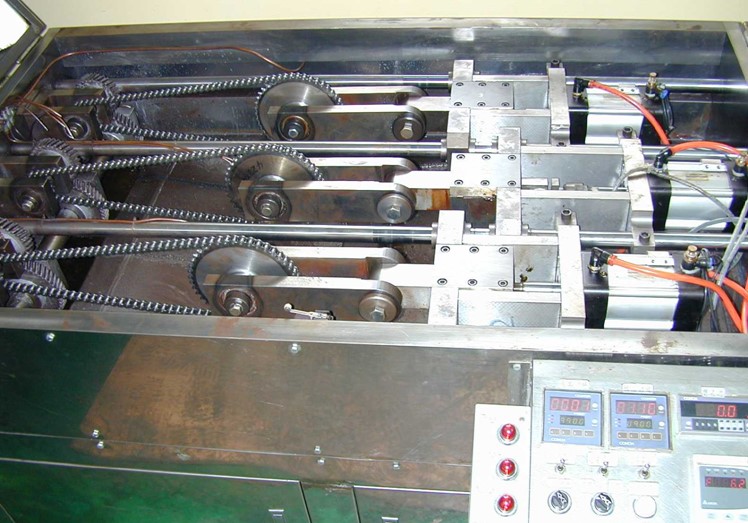
At present, there is no international standard for testing roller chain wear. Most manufacturers conduct their own simulated wear resistance tests under conditions that closely resemble real-world applications. A common setup involves using two sprockets—one driven by a motor to control speed, and the other connected to a pneumatic or hydraulic cylinder to apply a constant load on the chain. The picture shows the structure of our in-house wear-resistant testing machine. The driving sprocket is located on the left side, and the driven sprocket on the right side is connected to a pneumatic cylinder that applies continuous tension to simulate load during operation.
2. Example of Testing Conditions
Since there is no unified test standard, each manufacturer defines its own wear-resistant testing conditions.
The following example is the testing condition for our 428H O-Ring chain.
- Chain Length: 130 Pitches
- Applied Load: 70 kgf
- Sprockets: Driving sprocket – 15 teeth; Driven sprocket – 41 teeth
- Chain Speed: 457.2M/min
(Driven by a 15T sprocket rotating at 2400 rpm, simulating a motorcycle speed of approximately 80 km/hr)
3. Chain Elongation Measurement
Since chain elongation and wear occur during operation, the original chain length should be measured before testing begins. The chain should then be re-measured at regular intervals (e.g., every 20 hours of operation or every 1,000 km) to monitor wear.
Note: If the chain continues to operate after reaching an elongation of 1.5%, the engagement between the chain and sprocket teeth may deteriorate, potentially leading to chain breakage or sprocket damage. Prolonged use beyond this limit increases the risk of malfunction or severe damage to both components.
How to calculate Chain Elongation

Example
Original length before testing: 1017.47mm/80L
- Measured length after testing 5000km: 1017.83mm/80L
- Chain elongation (%): [(1017.83-1017.47)/1017.47]*100%=0.035%
- Measured length after testing 10000km: 1019.14mm/80L
- Chain elongation (%): [(1019.14-1017.47)/1017.47]*100%=0.164%
4. Roller Chain Wear Testing Curve
Example 1 : 428H O-Ring wear resistant testing curve

Example 2 : 40 chain wear resistant testing curve

Conclusion: Purpose and Benefits of Roller Chain Wear Testing
Continuous Quality Improvement:
Chain wear testing validates the effectiveness of upgrades in material composition, heat treatment techniques, and surface finishing methods, enabling us to refine and enhance product quality.
New Product Development:
It helps confirm whether new chain models or designs meet performance expectations, especially in terms of durability and resistance to wear.
Lubrication Evaluation:
By testing different lubricants, we can determine whether new oils or greases improve wear resistance and overall chain performance.


